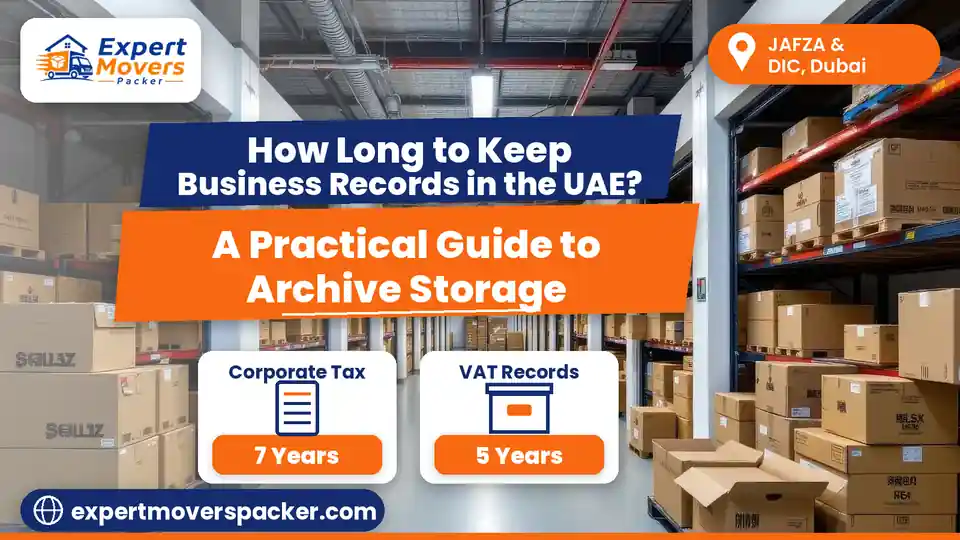
Quick answer: Most UAE companies should plan to keep their business records for at least seven years. Corporate Tax records must be kept for seven years after the end of each tax period, VAT records for five years, and records linked to real estate for 15 years. If your office is running out of room for files, document storage near JAFZA and Dubai Industrial City keeps them safe and easy to find without taking up desk space.
When companies move offices, archive boxes are often the part nobody planned for. Files have been kept “just one more year” in a storeroom, a meeting room corner or under desks, and the same question comes up: how long do we actually have to keep all this?
This guide explains the main retention periods, which documents to keep, and how to box and label them so you can find a single invoice years later.
This article is general guidance, not legal or tax advice. Rules can change, and your free zone or auditor may ask for more. Check your own position with your accountant or the Federal Tax Authority.
How Long Do UAE Companies Have to Keep Records?
Different laws set different periods. These are the main ones most companies in Dubai deal with.
| Record type | Minimum period | Where the rule comes from |
|---|---|---|
| Corporate Tax records and supporting documents | 7 years after the end of the tax period | Federal Decree-Law No. 47 of 2022 on Corporate Tax, as reminded by the FTA |
| VAT records, including tax invoices and credit notes | 5 years after the end of the tax period | UAE VAT law and Executive Regulations |
| Records linked to real estate | 15 years after the end of the tax period | UAE VAT Executive Regulations |
Because the Corporate Tax period is the longest one that applies to most businesses, many companies now use seven years as their default rule for all financial records. It is easier to manage one rule than three.
If your business holds property or capital assets, keep those records for the full 15 years.
Do Free Zone Companies Follow the Same Rules?
Yes, the federal tax rules apply to free zone companies too, including companies in JAFZA and Dubai South. Your free zone authority, your bank or your auditor may also ask you to keep certain documents for longer. Ask your accountant to confirm the full list for your company.
Which Documents Should You Keep?
As a starting point, most companies keep:
- Sales and purchase invoices
- Credit notes and debit notes
- Bank statements and payment records
- Contracts with customers, suppliers and landlords
- Payroll records
- Fixed asset registers
- Import, export and customs documents
- Corporate Tax and VAT workings and returns
- Audited financial statements
Trading companies in Dubai Industrial City and JAFZA often add delivery notes, packing lists and shipping documents, because these support the figures in their accounts.
Should You Keep Paper Records or Scan Them?
Many companies scan their records so they can search them quickly. Scanning is useful, but it does not always mean you can throw the paper away.
Some originals may still be needed, for example signed contracts or documents your auditor wants to see. Ask your accountant which originals you must keep and which ones a clear scan can replace.
A practical approach is to keep both for the most important records and store the paper copies outside the office.
How to Box and Label Business Records
Good labelling is what makes an archive useful. Without it, finding one invoice means opening 40 boxes.
- One financial year per box. Do not mix years. When a year reaches the end of its retention period, the whole box can be reviewed together.
- One record type per box where possible. Keep sales invoices, purchase invoices and bank records apart.
- Label every box the same way. Company name, financial year, record type and box number.
- Keep an index list. A simple spreadsheet with box number, contents, year and a “review after” date.
- Do not overfill boxes. A full box of paper is heavy and the bottom files get damaged. Leave a little space.
- Keep boxes off the floor. Shelving protects paper from spills, dust and damp.
The “review after” date is the column people forget. It turns a pile of old boxes into a plan: each year you check which boxes have passed their retention period and ask your accountant before anything is destroyed.
Office Storeroom vs Off-Site Archive Storage
| Office storeroom | Off-site archive storage | |
|---|---|---|
| Cost | Uses office space you already pay rent for | A monthly charge for the shelf space or volume used |
| Space | Takes room from staff, stock or meetings | Frees the room for your business |
| Finding a file | Depends on how well the room is kept | Boxes are indexed and requested by reference |
| Risk | Spills, clutter and staff moving boxes around | Stored away from daily office activity |
For a small company with a few boxes, a tidy storeroom can be enough. Once records grow every year, off-site storage usually makes more sense than giving up office space to paper.

How Archive Storage Works With Us
We provide business storage for companies in Dubai Industrial City, JAFZA, Dubai Investment Park and Dubai South from our warehouse in Jebel Ali.
For records, the process is simple:
- Collection: our crew collects your archive boxes from your office.
- Indexing: boxes are checked in against your list, so you know exactly what is stored.
- Retrieval: you ask for a box by its reference number and we deliver it. Retrieval time and charges are agreed in your written quote.
- Billing: storage is charged by the shelf space or volume your boxes use, billed monthly. Our guide to pallet, shelf and CBM storage billing explains how each method works.
Send us the number of boxes and your office location on WhatsApp at +971 50 231 2653, and we reply with a written price. You can also read more on our storage services in Dubai Industrial City page.
Frequently Asked Questions
How long should a UAE company keep invoices?
VAT invoices must be kept for at least five years. Because Corporate Tax records must be kept for seven years, many companies keep all invoices for seven years to be safe.
Can I destroy records after seven years?
Not automatically. Check first that no longer period applies, such as 15 years for real estate records, and that no audit, dispute or contract requires them. Ask your accountant before destroying anything.
Do I have to keep paper copies if I have scans?
It depends on the document. Some originals may still be needed. Your accountant can tell you which records a scan can replace.
Can stored files be delivered back to my office?
Yes. You request a box by its reference number and we deliver it. The delivery time and charge are set out in your written quote.